
19 Housing
National policy
19.1 Section 5 of the NPPF sets out the Government’s objective to ‘significantly boost the supply of homes’, with a local housing need and subsequent housing requirement that is determined using the standard method. Within the context of the housing requirement and establishing need, NPPF paragraph 63 states that “the size, type and tenure of housing need for different groups in the community should be assessed and reflected in planning policies”, and further lists the range of groups that should be includedThese groups should include (but are not limited to) those who require affordable housing (including Social Rent); families with children; looked after children; older people (including those who require retirement housing, housing with-care and care homes); students; people with disabilities; service families; travellers; people who rent their homes and people wishing to commission or build their own homes.
19.2 Where there is a need for affordable housing, planning policies should set out the type of affordable housing required, ‘and expect it be met on site’ (NPPF, paragraph 64). Policies should set out the (minimum) proportion of Social Rent homes required; and meet identified local needs across all sectors including Social Rent, other affordable housing for rent, and affordable home ownership tenures (NPPF, paragraph 66).
19.3 Development proposals involving the provision of new homes, that are in the Green Belt will be subject to the ‘Golden Rules’NPPF, paragraphs 156-157 that require a higher level of affordable housing than would apply to non-Green Belt proposals; and this level is required to be at least 50% of the total housing proposed.
19.4 Provision of affordable housing should not be sought for residential developments that are not major developments, other than in designated rural areas where policies may set out a lower threshold of 5 units or fewer.
19.5 Planning policies and decisions should avoid the development of isolated homes in the countryside unless there is an essential need for a rural worker, including those taking majority control of a farm business, to live permanently at or near their place of work in the countryside (NPPF paragraph 84).
19.6 National policy enables the Council to bring in higher optional technical standards for accessible and adaptable dwellings and wheelchair user dwellings. Councils can also require through the nationally described space standards to be followed that set internal space requirements.
19.7 Paragraph 76 of the NPPF states “Local planning authorities should support the development of exception sites for community-led development on sites that would not otherwise be suitable as rural exception sites.” These sites should comprise affordable housing, but the local planning authority may allow a proportion of market homes. Sites should be adjacent to settlements, proportionate in size to them (not larger than one hectare in size or exceed 5% of the size of the existing settlement unless the development plan makes specific provision to exceed these limits. Sites should not compromise the protection to assets of importance such as local green space, Green Belt and nationally important designations.
19.8 Community-led is defined as taken forward by, or with, a not-for-profit organisation and be managed and democratically controlled by its members.
19.9 NPPF sets out that local planning authorities should support opportunities to bring forward rural exception sites that will provide affordable housing to meet identified local needs and consider whether allowing some market housing would help to facilitate schemes. In the Green Belt limited affordable housing for community needs under policies in the development plan, including rural exception sites, are not considered inappropriate development.
19.10 Annex 2 of NPPF defines a rural exception site as: “Small sites used for affordable housing in perpetuity where sites would not normally be used for housing. Rural exception sites seek to address the needs of the local community by accommodating households who are either current residents or have an existing family or employment connection. A proportion of market homes may be allowed on the site at the local planning authority’s discretion, for example where essential to enable the delivery of affordable units without grant funding.”
Evidence base
- Housing Needs Assessment (to be prepared)
- Self-build and Custom Housebuilding Register
- First Homes (National Planning Guidance)
- National Space Standards Evidence (to be prepared)
- Housing: optional technical standards (National Planning Guidance)
- Higher Education enrolment data (Higher Education Statistics Agency)
- Local Plan Annual Monitoring Reports
- Rural Worker Dwellings - Advice Note (2022)
Key issues
- Housing Need Assessment (to be prepared) will provide the basis for delivering the mix of homes required and requirement for affordable housing.
- Ensuring development meets the needs identified in the Housing Needs Assessment (to be prepared).
- Threshold for provision of affordable housing especially in rural areas.
- New national policy that replaced entry level exception sites and can apply to sites adjacent to existing settlements whether large urban areas or rural settlements.
- Local Plan monitoring information identified that rural exception sites were often driven by a site being promoted before the identification of a local need.
- Evidence of local need for rural exceptions sites being overstated and first occupation not local residents.
- Most rural exception sites delivered since the start of the current plan have been in the smaller settlements in the north of the borough and relatively close to larger urban areas
Current adopted policy
| Local Plan | Policy reference | Policy summary |
|---|---|---|
| Local Plan (Part One) | SOC 1 Delivering affordable housing | Sets thresholds and a percentage target for affordable housing as part of all new residential development proposals. |
| Local Plan (Part One) | SOC 2 Rural exception sites | Sets out the general criteria of an exception site, including location, size, and evidence required. Does allow small subsidiary element of market housing. |
| Local Plan (Part One) | SOC 3 Housing mix and type | Encourages the inclusion of a range of housing types, tenures and sizes (market and affordable) as part of all new residential development. |
| Local Plan (Part Two) | DM 19 Proposals for residential development | Based on the spatial strategy of Local Plan (Part One), the policy lists the type of proposals that would be acceptable in each category of spatial area (as defined in Local Plan (Part One)). |
| Local Plan (Part Two) | DM 20 Mix and type of new housing development | Encourages the delivery of a mix of housing types on major developments to meet local housing needs. |
| Local Plan (Part Two) | DM 21 Development within the curtilage of a dwellinghouse | Sets out the type of development that is acceptable within the curtilage of existing dwellinghouses, including changes to curtilage, boundaries and hard surfacing. |
| Local Plan (Part Two) | DM 22 Change of use to dwellinghouses and residential conversions | A criteria-based policy for proposals that would change the use of buildings to residential use (by spatial area category). |
| Local Plan (Part Two) | DM 23 Delivering affordable housing | Sets out the order pf preference for the delivery of affordable housing i.e. on-site; off-site; and financial contribution. |
| Local Plan (Part Two) | DM 24 Rural exception sites | Policy requires local need to be demonstrated through an up-to-date independent assessment of need prepared by a Parish Council or in collaboration with a Parish Council. Local connection criteria- established and requirements for identifying suitable sites. |
| Local Plan (Part Two) | DM 25 Essential rural workers dwellings | A criteria-based policy for proposals seeking to develop rural worker dwellings in the countryside. |
| Local Plan (Part Two) | DM 26 Specialist accommodation | A criteria-based policy for proposals to develop specialist accommodation including accessible and adaptable homes; accessibility; and affordable housing. |
| Local Plan (Part Two) | DM 27 Student accommodation | Sets the requirements for the location and standards for new student accommodation including impacts of proposals. |
| Local Plan (Part Two) | DM 28 Houses in Multiple Occupation | Sets out criteria for when the change of use from a dwelling to a House in Multiple Occupation (HMO) will be supported. |
Suggested policy approach
19.11 The Housing Needs Assessment (to be prepared) will provide the basis for new Local Plan policies that will set out how new residential developments will be expected to provide a suitable mix of housing to meet residents needs. Unlike the current Local Plan the intention will be to have a much clearer approach to residential mix e.g. split by size (bedrooms) for both market and affordable housing. In line with NPPF the Council is committed to ensuring that future housing provision meets the needs of residents with disabilities which will include learning difficulties. Detailed requirements will be provided for adaptable and accessible dwellings. If justified, larger developments will also be required to make provision for self-build and custom housebuilding plots. Local Plan (Part One) policy SOC 3 and Local Plan (Part Two) policy DM 20 will be replaced by a single policy approach in relation to development requirements on residential sites to ensure clear guidance is given on expected mix of residential schemes.
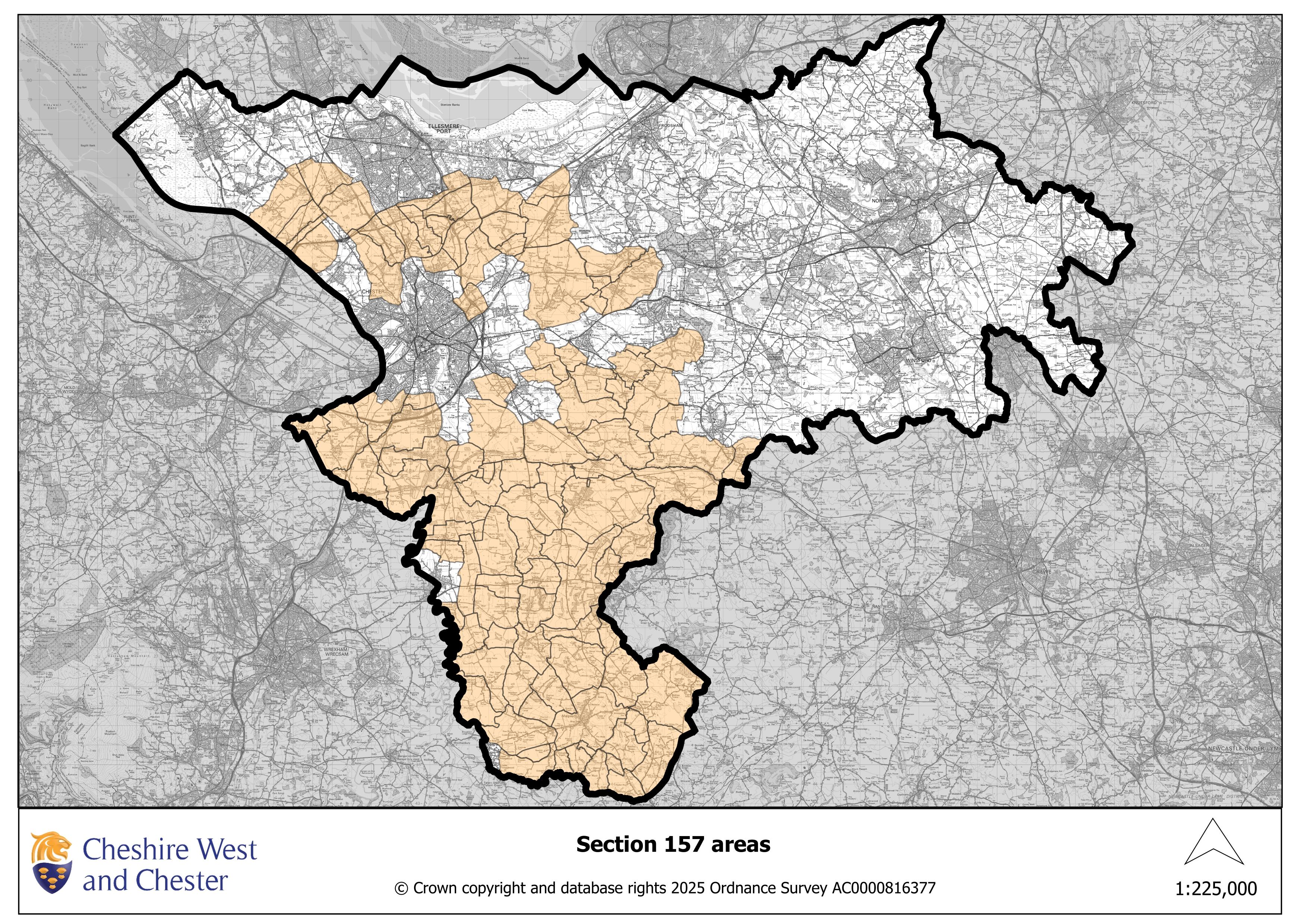
19.12 If justified, Local Plan (Part One) policy SOC 1 will be amended based on the Housing Needs Assessment (to be prepared) recommendations in relation to identifying the level (%) affordable housing requirement by borough or sub-area and tenure types. This can include provision for First Homes. The current Local Plan policy approach requires developments in urban areas of 10 or more dwellings (or 0.3 hectares) and in rural areas of three of more dwellings (or 0.1 hectares) to provide affordable housing as part of the development. The current policy sets out that the urban areas are: Chester, Ellesmere Port, Winsford and Northwich. Planning Practice Guidance now states the threshold for all areas should be 10 dwellings or more unless in a designated rural areaAreas designated as ‘rural’ under Section 157 of the Housing Act 1985: The Housing (Right to Buy) (Designated Rural Areas and Designated Regions) (England) (No.2) Order 2004 where a lower threshold of 5 units of fewer can be set. As per the map below the following areas of the borough are designated under Section 157. The Local Plan (Part One) policy SOC 1 will be updated to reflect the NPPF but for the rural areas it is proposed to require sites for 3 or more dwellings to provide affordable housing. It is appreciated that Neighbourhood Plans may set different requirements and that many rural areas of the borough are not designated, and views are welcome on this.
Map 19.1 Section 157 areas (View full image)
19.13 Local Plan (Part One) policy SOC 1 in relation to dispersing affordable housing throughout the site and ensuring market and affordable homes being indistinguishable will be retained. The requirements of Local Plan (Part Two) policy DM 23 in relation to on-site provision will continue as this is the best guarantee of delivering affordable housing. Spatial area references in relation to off-site provision will be amended to reflect the chosen spatial strategy and Housing Needs Assessment (to be prepared) recommendations.
19.14 Local Plan (Part Two) policy DM 26 for specialist accommodation will be amended as specific requirements are likely to be incorporated into the policy approach on overall housing mix and type, but other provisions of the current policy will still apply. This will include the requirement for market led specialist housing to provide affordable housing in line with existing policy requirements.
19.15 The Housing Needs Assessment (to be prepared) will also investigate future need for student accommodation and this will be incorporated into an update of Local Plan (Part Two) policy DM 27, as will support for purpose-built accommodation under Local Plan (Part One) policy SOC 3. Other aspects of the current policy approach will be retained and views will be sought if an additional policy is required for the University of Liverpool, Leahurst campus.
HO 1
Mix and type of housing in new developments and specialist housing
Current Local Plan (Part One) policy SOC 3 and Local Plan (Part Two) policy DM 20 will be substantially amended to reflect the evidence of the Housing Needs Assessment (to be prepared). The new policy approach will provide detailed policy requirements e.g. % of 1-2 bed dwellings including by tenures; % of plots for self-build and custom housebuilding; requirements to meet the needs of an ageing population and meeting the needs of residents with disabilities.
If justified by the evidence a new policy will be brought in to require national space standard to be met for internal space in new homes.
Specialist Accommodation
The content of Local Plan (Part Two) policy DM 26 concerning the future requirements for extra care, older persons and accessible and adaptable homes in new developments will be incorporated into the overall policy approach to mix and type but locational requirements will be kept ensuring these developments are in accessible areas with good accessibility to range of facilities. The suggested policy approach will resist extra care developments in the countryside outside of settlements.
Student accommodation
Local Plan (Part One) policy SOC 3 and Local Plan (Part Two) policy DM 27 will be amended to reflect any future needs identified through the Housing Needs Assessment (to be prepared). Local Plan (Part One) policy SOC 3 in relation to support for specialist student accommodation in areas accessible to the University of Chester is proposed to be retained. The suggested policy approach will continue to link to policy for the University of Chester, proposed to be taken forward in CH 1 ‘Chester’, and other Local Plan policy requirements in relation to location and accessibility in terms of walking distance to campus and cumulative impact of proposals.
Requirements for standard of accommodation, management plans and future reuse will be retained.
Question HO 1
Do you agree with the suggested policy approach towards mix and type and specialist housing in new developments, as set out in HO 1 ‘Mix and type of housing in new developments and specialist housing’ above? If not please suggest how it could be amended?
Question HO 2
Should the housing mix and type and specialist housing be delivered through a percentage policy approach that sets requirements for each category of housing?
Question HO 3
Do you agree with the approach to student accommodation, and should additional consideration be given to the University of Liverpool Leahurst campus?
HO 2
Delivering affordable housing
The suggested policy approach will replace Local Plan (Part One) SOC 1 and Local Plan (Part Two) DM 23, and will set out the % of affordable housing required across the borough including potentially by sub-area. The approach intends to reflect the government’s requirement for housing sites in the Green Belt to provide at least 50% affordable housing. The policy approach will specify the type of affordable housing required.
Affordable housing will be required on all sites of 10 or more dwellings but in designated rural areas, the requirement will be triggered by three or more dwellings. This requirement is applicable to all self-contained units, including older persons and student accommodation.
Affordable homes will be sought within all new development that include the provision of new homes, unless there are exceptional circumstances which can be demonstrated to justify off site contributions, providing that:
- Affordable homes must be indistinguishable from market housing, achieving high quality design and must be dispersed throughout the site.
- Provision must be made for affordable homes to remain affordable in perpetuity.
Question HO 4
Do you agree with the suggested policy approach towards delivering affordable housing, as set out in HO 2 ‘Delivering affordable housing’ above? If not please suggest how it could be amended?
Question HO 5
Do you have any views on thresholds for affordable housing in relation to applying a lower threshold for designated rural areas and what approach could be taken to parts of the borough not subject to the designation?
19.16 The suggested policy approach will need to reflect the chosen spatial strategy as to what settlements are identified and the extent of the countryside designation. The basic principles of Local Plan (Part Two) policy DM 19 setting out the criteria for residential development in the countryside, especially for replacement of buildings on previously developed land, are considered important to retain in the plan.
19.17 Local Plan (Part Two) policies DM 21 and DM 22 are currently applied to many planning applications in the borough, and already defer to NPPF in relation to Green Belt. Local Plan (Part Two) policy DM 21 sets out in the supporting text more restrictive approaches to replacement dwellings and extensions in the Green Belt.
HO 3
Proposals for residential development
Local Plan (Part Two) policy DM 19 will either be retained as a separate policy or the general principles incorporated into other policies of the new Local Plan.
For residential development in settlements, the approach to protecting garden land and character should continue to be reflected in the new plan, along with criteria relating to development in the countryside, as to where residential development will be allowed.
The suggested policy approach is to largely retain Local Plan (Part Two) policies DM 21 and DM 22 with only minor amendments.
Question HO 6
Do you agree with the suggested policy approach for residential development proposals, as set out in HO 3 ‘Proposals for residential development’ above? If not please suggest how it could be amended?
Question HO 7
Are Local Plan (Part Two) policies DM 19, DM 21 and DM 22 working effectively; remain relevant; or are all issues covered by current national policy and guidance?
Question HO 8
Within this policy approach (or elsewhere) should the new Local Plan set out more detail on what development is appropriate in the Green Belt, with respect to, for example, house extensions; what is small scale/subordinate (not increasing size of a dwelling by more than 30%) etc?
Question HO 9
Are there any local/borough specific issues e.g. intensification of garden development, infill or backland development, change of use of garages to residential, that justify additional/continuation of policy?
Question HO 10
Should living-over shops be included in a new/amended policy?
19.18 In the absence of detailed national guidance, Local Plan (Part Two) policy DM 25 provides essential guidance for planning applications for permanent and temporary rural workers dwellings. There have been issues where the size of a dwelling has made it difficult for other rural workers to subsequently afford the dwelling. The Council has prepared an advice note that provides detailed guidance on the financial information to support an application and the use of planning obligations to tie the land to the dwelling. To ensure the dwelling is commensurate with the established functional requirement and remains as affordable housing that dwellings should not exceed 106 m2 (internal floorspace).
HO 4
Essential rural workers dwellings
The suggested policy approach is to retain Local Plan (Part Two) policy DM 25 including the requirement that should the need cease, that the dwelling remains available to meet affordable housing needs.
Further detail may be added to how the property should remain affordable in the future considering consultation responses.
Cross referencing to other planning requirements are proposed to be deleted.
Question HO 11
Do you agree with the suggested policy approach towards essential rural workers dwellings, as set out in HO 4 ‘Essential rural workers dwellings’ above? If not please suggest how it could be amended?
Question HO 12
How can it be ensured that if the use ceases the property can meet affordable housing needs?
Question HO 13
Would it be useful for elements of the Council’s Rural Worker Dwellings - Advice Note to be added to the policy approach?. Please specify which elements?
Community-led housing
19.19 In relation to community-led housing the consultation will seek views on whether a policy is required and if so, what this should contain. If a policy is considered necessary, the approach at this stage would not be to exceed the size limits set out in national policy. The Local Plan will promote an approach to accommodating new development in sustainable locations and therefore community-led housing will not be suitable in all settlements.
Question HO 14
If a policy for community-led housing is required, what should it include, and do you agree that the Local Plan should not increase the maximum size limit for these developments as set out in national guidance?
Rural Exception Sites
19.20 The suggested approach would be to combine Local Plan (Part One) policy SOC 2 and Local Plan (Part Two) policy DM 24 but seek views on whether rural exceptions should only apply to those settlements that are more remote from large urban areas given the wide opportunities to access housing in these urban areas. The outcome of the consultation on the spatial strategy options will determine which settlements would be suitable as locations for accommodating development. Given the Government’s local housing need requirement is significantly higher than the current planned requirement, the amount of affordable housing across the borough will significantly increase, which may limit the need for rural exception sites.
HO 5
Rural exception sites
Retain the overall approach in Local Plan (Part One) policy SOC 2 to sites being small in scale and on the edge of identified rural settlements, and be modest and in keeping with the form and character of the settlement.
Retain the current approach in Local Plan (Part Two) policy DM 24 to ensure that there is a genuine local need to be identified through an independent assessment prepared or commissioned by the Parish Council. Schemes will need to remain affordable in perpetuity.
In addition, the current approach in Local Plan (Part Two) policy DM 24 would be retained to ensure that once a need has been established, a thorough assessment of sites is undertaken led by the Parish Council and in consultation with the local community. This assessment should be evidenced and relate to need identified.
This suggested policy approach would keep criteria ensuring that alternative sites within a settlement aren’t available to meet the need including on sites for market housing where affordable housing is provided. Add that other sites may be identified through the Brownfield Land Register and Land Availability Assessment.
The current restrictions and local connection test would be retained as follows but also that this may differ where set out in a neighbourhood plan:
- currently live in the parish and have been living there continuously for at least five years; or
- have permanent employment in the parish; or
- have close family members (defined as children, parents, siblings only) who have been residing in the parish continuously for at least five years; or
- people who have previously lived in the parish for a continuous period of at least 10 years.
Question HO 15
Do you agree with the suggested policy approach towards rural exception sites, as set out in HO 5 ‘Rural exception sites’ above? If not, please suggest how it could be amended?
Question HO 16
Should the policy approach towards rural exception sites continue to apply to all identified smaller settlements or just those in more remote areas of the borough?
Question HO 17
Should market housing still be allowed through the policy on rural exception schemes?
19.21 The Council has implemented three Article 4 directions relating to proposed Houses in Multiple Occupation (HMOs) in areas of Chester. An imbalance in communities can sometimes have a detrimental impact on neighbourhoods, therefore we propose to retain the content of Local Plan (Part Two) policy DM 28.
HO 6
Houses in Multiple Occupation
The policy approach will take forward Local Plan (Part Two) policy DM 28 which sets out criteria for when the change of use from a dwelling to a House in Multiple Occupation (HMO) will be supported, where it would:
- not increase the concentration of HMOs with 50 metres more than 15% total number of dwellings
- not sandwich an existing household between HMOs
- meet the Council's amenity standards (Physical Property Standards - Shared houses/flats 2012)
- make provision for cycle parking, and waste and recycling facilities
- protect the overall character of an area
- be supported by evidence there is no reasonable demand for the existing dwellinghouse
Question HO 18
Do you agree with the suggested policy approach towards Houses in Multiple Occupation, as set out in HO 6 ‘Houses in Multiple Occupation’ above? If not please suggest how it could be amended?