Call for Sites 2026
The 'Call for Sites' will be open between Wednesday 14 October and Friday 6 November 2026. This is an opportunity to tell us about any land/site for potential development that has not been submitted to us previously.

The World Health Organisation (WHO) and United Nations (UN) international policy framework consistently supports the principle that planning should create healthy, inclusive and sustainable places by addressing the social determinants of health, promoting wellbeing, reducing inequalities, improving access to services and green infrastructure, and ensuring that urban development contributes to better health outcomes for all communities.
The NPPF places a strong emphasis on creating healthy, inclusive and safe communities. The NPPF requires planning policies and decisions to support places that:
The NPPF also expects planning authorities to:
Chapter 14 of the NPPF refers to the objective of promoting high quality, healthy, inclusive and sustainable places. The NPPF promotes accelerated delivery of housing, including higher density development in town centres and locations that have a high level of connectivity, including public transport hubs - providing opportunities for healthier, walkable neighbourhoods.
The Healthy and Safe Communities PPG provides advice on how the planning system should support health, wellbeing and inclusive communities. The PPG recognises that the built and natural environment are major determinants of health and wellbeing. The guidance highlights that planning can contribute both to:
Local plans should:
The PPG emphasises that planning should support the delivery of:
Health infrastructure should be considered early in the plan-making process to ensure development is supported by adequate services.
NHS Cheshire and Merseyside Health and Care Partnership's "All Together Fairer" Plan (2024-2029) identifies reducing health inequalities as its primary objective. The strategy recognises that health outcomes are strongly influenced by the social, economic and environmental conditions in which people live. It promotes a place-based approach focused on improving population health, supporting healthy lifestyles, creating inclusive communities, enhancing access to services and addressing the wider determinants of health, including housing, employment, education, transport and the quality of the built and natural environment.
The current Cheshire West and Chester Health and Wellbeing Strategy, known as the Place Plan 2019-2026 (refreshed in 2024), provides the shared vision for the Council, NHS, public health, voluntary sector and other partners to improve health outcomes and reduce inequalities across the borough.
The strategy seeks to reduce health inequalities and improve healthy life expectancy by addressing the wider determinants of health, creating healthy places, encouraging healthy lifestyles and delivering integrated health and care services.
The strategy aims to:
A major focus is reducing the health gap experienced by residents living in more deprived communities.
For planning policy, the strategy supports:
In October 2020, Cheshire West and Chester Council formally declared a Poverty Emergency. Following the declaration, the Council developed the Fairer Future Strategy 2022-2032, a ten-year programme to reduce poverty and financial hardship across the borough. The headline ambition is to: Halve the number of children living in absolute poverty by 2032. The Poverty Emergency commits Cheshire West and Chester Council to tackling poverty as an equality, health and social justice issue, with a long-term objective of reducing deprivation, narrowing inequalities and creating a fairer future for all residents.
The Covid-19 pandemic had a big impact upon health, and the long-term impacts are still yet to be known. Waiting lists for hospital treatment nationally are still high at 5.7 million in January 2026, however this is an improvement from the record high figures of 7.2 million in 2023. This demonstrates that the health care systems are slowly recovering from the pandemic.
Deprivation of a social, economic or environmental nature can lead to social exclusion and social problems. These include increases in crime rates and decreases in the quality of the housing stock, living conditions, health and educational attainment. Some indicators measure the effects of deprivation and can act as secondary indicators themselves. The measure of the percentage of the population who smoke, binge drink or are obese can, to some degree, identify the scale of deprivation.
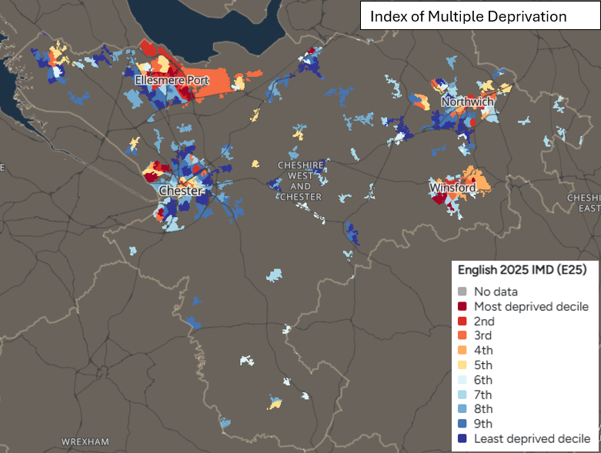
Cheshire West and Chester is a comparatively affluent area. However, whilst overall the borough scores comparatively well on the Index of Multiple Deprivation, Cheshire West and Chester does have some of the worst areas of deprivation in the country, measured at Lower layer Super Output Area (LSOA) level. There are 29,512 residents living in 19 neighbourhoods (LSOAs) that rank in the 10% most deprived neighbourhoods in England. Two of these neighbourhoods rank in the 1% most deprived areas in England. These neighbourhoods are in Lache and Westminster Wards. High levels of deprivation are predominately concentrated in the four urban areas (Chester, Ellesmere Port, Winsford and Northwich).
According to 2023 data 10.1% (16,219) of households were living in fuel poverty compared with 11.4% in England. The Cheshire West and Chester Fuel Poverty Strategy (2023) includes actions to improve energy efficiency in the home, increase renewable and low carbon technologies in domestic properties and encouraging behaviour change to reduce energy consumption.
The new Local Plan will be subject to a Heritage Impact Assessment, which will be used to feedback into subsequent stages of the Sustainability Appraisal.
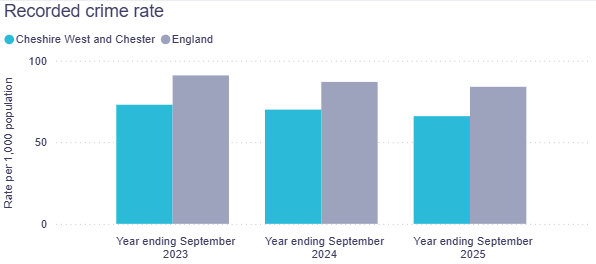
Safe and healthy neighbourhoods are fundamental to the economic, social and environmental well-being of the community. Crime is not a particular problem in CW&C when compared with England and has remained relatively stable over the past few years with an increase in the crime rate nationally.
In the Our Place Survey (Autumn 2021) 92 per cent of respondents felt safe during the day and 60 per cent after dark. These are borough wide figures and further analysis into the spatial area should be undertaken to understand if this is truly representative. Well-designed places can reduce the opportunity for crime and the fear of crime, helping to create safer, more attractive environments. Consideration of crime reduction measures at all stages of the planning process has a demonstrable positive impact on levels of crime and anti-social behaviour.
Such proactive measures can have a significant impact on public spending on community safety issues and should therefore form a key consideration in the design and layout of new development. The recognised standard for incorporating these principles into the planning process is ‘Secured by Design’.
Health and wellbeing can also be improved by access to various forms of green infrastructure, either for recreation or physical exercise. The Open Space Study (2017) provides an assessment of need of all accessible open space in the borough in terms of quality, quantity and access. The study then sets local open space standards based on this assessment, and these are included within the Local Plan (Part Two). The study highlights deficiencies in provision in at least two open space typologies within each area profile, with deficiencies in youth play space in all areas. In addition, the Playing Pitch Strategy was updated in February 2025 and provides up to date information on the existing and future needs for all outdoor sports facilities in terms of quality, quantity and location.
Measurement of social value within the built environment is rapidly evolving, with no common methodology to provide a consistent definition or approach. Within the Delivery Social Value: Measurement by the Green Building Council they suggest that “social value is a term for economic, environmental and social benefits that are experienced by people. To understand their worth, these benefits are often measured and sometimes assigned a financial figure”.
Recent changes to the NPPF may result in changes to health, wellbeing and equality.
The Open Space study is being updated and will assess if any wards are deficient or surplus to different open space typologies. Open space standards will also be updated for the new Local Plan that will require development to provide open space.
The Council is producing a borough wide Design Code that will set out the design expectations for new development. This enables the built environment to embed health opportunities during the design stage.
The new Local Plan can support the proactive approach to health and wellbeing through the promotion of active travel, protection for open spaces as well as designing new developments with health as a priority. Not only does this benefit health, but climate, inequality and air quality. Ensuring a high-quality design and access to open spaces in all areas of the borough, regardless of socio-economic status ensures opportunities to improve health for all.
| Sustainability objective | Appraisal criteria / sub-objective | Baseline indicator |
|---|---|---|
| Improve health, safety and wellbeing | Will it promote active lifestyles? | Percentage of physically active adults |
| Obesity percentages of children in the borough | ||
| Will it increase the quantity or quality of open space? | Total amount of open space per 1,000 persons | |
| Will it reduce opportunities for crime? | Domestic burglaries per 1000 households | |
| Violent crime per year per 1000 population in the LA area | ||
| Will it affect the fear of crime and feelings of safety? | Fear of crime (Community Survey) | |
| Will it improve road safety? | Total number of people killed or seriously injured (KSI) in road traffic collisions | |
| Total number of children (aged under 16) killed or seriously injured (KSI) in road traffic collisions | ||
| Will it help to protect existing health or community facilities and services? | Number of applications approved involving loss of a health or community facility (e.g demolition or conversion to an alternative use) | |
| Reduce noise pollution | Will it reduce noise pollution? | No indicator identified |