Call for Sites 2026
The 'Call for Sites' will be open between Wednesday 14 October and Friday 6 November 2026. This is an opportunity to tell us about any land/site for potential development that has not been submitted to us previously.

The UN Sustainable Development Goals (SDGs) include the following goals that are relevant to population and housing:
These objectives support the provision of sufficient, affordable and inclusive housing, sustainable communities and equal access to opportunities.
The Planning and Compulsory Purchase Act 2004 requires Local Plans to contribute towards sustainable development and provide an appropriate framework for housing delivery.
The Housing Act 2004 provides the legislative framework for housing standards and addressing housing need.
Reforms to the planning system were introduced by the Levelling-up and Regeneration Act 2023 and this establishes a revised framework for plan-making and housing delivery.
The National Planning Policy Framework (2026) (NPPF) places significant emphasis on addressing the national housing shortage and supporting the delivery of sustainable development. It requires local plans to provide for identified housing needs and maintain an adequate supply of developable land to support housing growth.
For housing, the NPPF requires local planning authorities to:
The NPPF also introduces stronger national support for development in sustainable locations and places increased importance on maintaining up-to-date local plans to provide certainty for communities and developers.
The national PPG provides detailed advice relating to:
The Cheshire and Warrington Combined Authority has started initial work on the Cheshire and Warrington Strategic Economic Framework. This emerging work will relate to housing growth, infrastructure and regeneration.
The Borough Plan 2024-2028 includes the following missions that are relevant to population and housing:
Cheshire West and Chester Housing Needs Assessment (2026) (HNA) provides the principal evidence base for establishing housing requirements, affordable housing needs, housing mix and specialist housing requirements.
Chester One City Plan sets out a new vision for how the public, private and community sector can work together to make Chester a fairer, stronger, and greener city by 2045.
The 2021 Census indicates that the population structure of Cheshire West and Chester increased by 8.4% from around 329,600 in 2011 to 357,200 in 2021. This increase is above the overall increase for England (6%), and higher than the population increase for the North West (5.2%). Cheshire West and Chester had the fourth largest increase in population in the North West region. However, in 2021 the borough ranked 22nd for total population out of the 309 local authority areas in England and has remained in that position since the last census in 2011.
The population change by age group in Cheshire West and Chester is dominated by an increase of 24.2% in people aged 65 and over. However there has also been an increase of 6.4% in children aged under 15 years (see Figure 9.1 below).
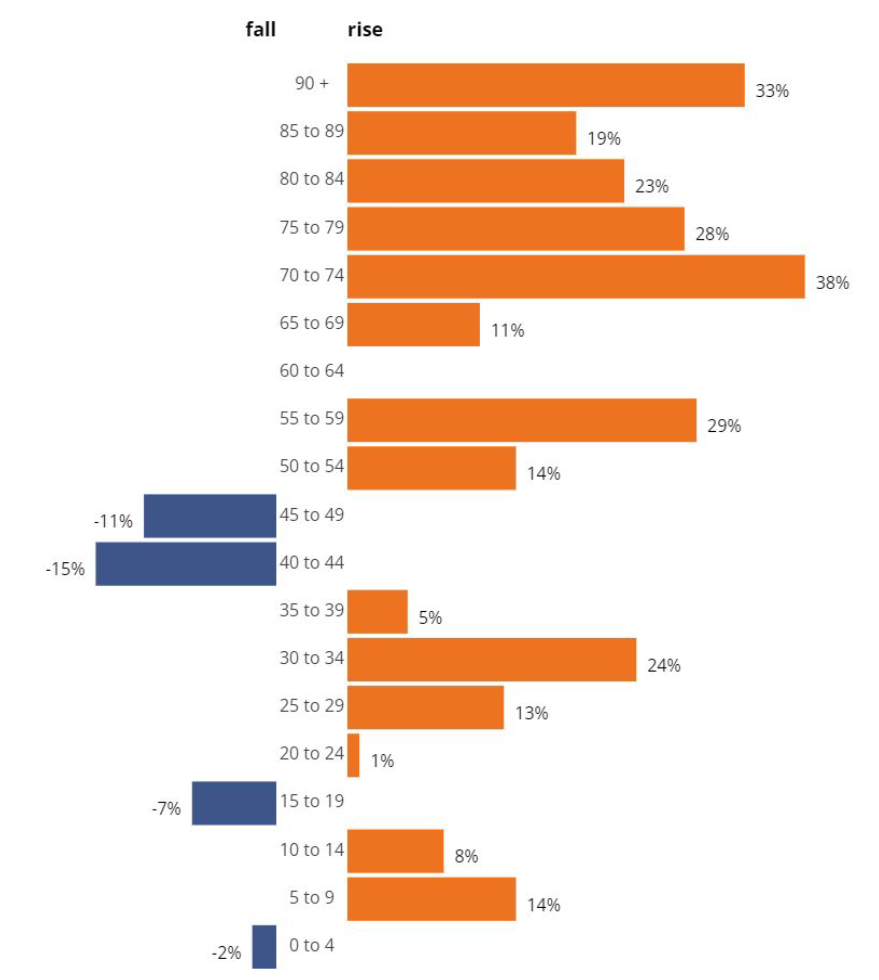
There are 167,820 dwellings in the borough that equates to 155,154 households (Source: MHCLG table 100 Dwelling Stock, ONS table TS041 Number of households). Around 66% of all households are one or two person households, a further 16% are three people households, and 17% are four or more people households (Source: Census 2021).
At April 2026 the median house price in Cheshire West and Chester was £265,000, reflecting a 2.2% increase from the previous year. The national median house price is £270,080. The affordability ratio (median house prices to work based earnings) for the borough is 6.20, and the five-year median average (2020 to 2025) is 7.30. The ratio for England is 7.6. The higher the affordability ratio, the less affordable it is to purchase a home. (Source: ONS House price statistics, ratio of house prices to work based earnings).
In September 2022, there were 1,462 long-term empty dwellings (1,038 empty for six months to two years, and 424 empty for over two years). More recent Council data indicates that there are more than 2,000 long-term empty properties within Cheshire West and Chester. Direct comparison with earlier years should be treated with caution due to changes in reporting and Council Tax premium rules. Nevertheless, the total remains below the 2015-2016 baseline of 2,246 long-term empty homes, indicating that a substantial number of properties have been brought back into use over the period.
A housing requirement, or Local Housing Need figure (LHN) is calculated using the Government's standard method for assessing local housing need, as set out in PPG: Housing and economic development needs assessments (Feb 2025). This uses the Governments’ live tables on dwelling stock (Table 125), and affordability data (median workplace-based affordability ratios) published by the Office for National Statistics at a local authority level. The calculation is set out below.
Local housing need (LHN)- Standard method calculation
Step1: Setting the baseline (0.8% of existing housing stock for the area)
Source: GOV.uk Open Data Live Table 125 Dwelling stock (including vacants)
Dwelling stock (2025) = 167,820
0.8% of dwelling stock = 1,343
Step 2: An adjustment to take account of affordability
Source: ONS Table 5c ratio of house price to workplace-based earnings
5-year average median workplace-based affordability ratio = 7.30
Adjustment factor: 1.437
Step 3: Calculating the LHN figure
Baseline dwelling stock X Adjustment factor = 1,343 X 1.437
Annual requirement = 1,930 dwellings
10-year requirement = 19,300 dwellings
15-year requirement = 28,950
The Housing Needs Assessment (HNA) 2026 identifies Cheshire West and Chester as a largely self-contained housing market area, although there are important relationships with Flintshire, Cheshire East and the Wirral.
The HNA identifies continued need for:
Affordability remains a significant issue. Median house prices are above the regional average, and home ownership is becoming increasingly difficult for younger households. The HNA also identifies a need for a greater supply of smaller and more affordable homes.
The HNA notes that around 70% of housing stock comprises homes with three or more bedrooms and that there is a relatively limited supply of smaller dwellings and flats. Significant levels of under-occupation exist within the existing housing stock.
Housing market and migration relationships extend beyond administrative boundaries. Key partners include neighbouring Council (Cheshire East, Warrington, Flintshire, and Wirral), Cheshire and Warrington Combined Authority, Homes England, and Registered Providers.
Strategic matters include housing market relationships; affordable housing provision; economic growth and labour markets; infrastructure provision; and specialist housing needs.
Recent changes:
Anticipated trends:
The following work will be required to assist in the preparation of a new Local Plan:
The new Local Plan will provide a policy framework for sustainable housing growth in the borough. It can consider and the land use requirements for different types of new housing across the borough. Policies will influence the range of future housing to be provided including, but not limited to, affordable housing, accessible and adaptable homes, specialist accommodation for older people and student accommodation.
The Local Plan will establish the borough’s housing requirement and allocate sufficient land for new housing to meet the future identified needs over the new plan period, including identify broad locations for new strategic development where relevant. It can contain policies and land allocations to support the delivery of new housing across the borough, promoting high quality design, sustainable development and the regeneration of brownfield land within key areas.
Issues:
Opportunities:
| Sustainability objective | Appraisal criteria / sub-objective | Baseline indicator |
|---|---|---|
| Provide high-quality, well-designed housing to meet identified needs | Will it help to meet identified housing needs? |
Net additional dwellings approved and completed Net additional G&T plots/pitches approved and completed Net additional student dwellings/units approved and completed Housing Delivery Test results Delivery against housing requirement 5-year housing land supply position |
| Will it help to provide an appropriate mix of housing types, sizes and tenures? |
Number and percentage of affordable dwellings completed Market and affordable housing completions by tenure, size and type Number of specialist housing units approved and completed |
|
| Will it provide well-designed housing? | No indicator identified |