Call for Sites 2026
The 'Call for Sites' will be open between Wednesday 14 October and Friday 6 November 2026. This is an opportunity to tell us about any land/site for potential development that has not been submitted to us previously.

The international plans and programmes that relate to biodiversity include the following: Convention on Biological Diversity (came into force December 1993); Bern Convention on Conservation of European wildlife and natural habitats (1979, came into force June 1982); EU Directive on the Conservation of Wild Birds (79/409/EEC and 2009/147/EC); Ramsar Convention on Wetlands of International Importance especially as Waterfowl Habitat (1971, as amended); EU Directive on the Conservation of Habitats and of Wild Fauna and Flora(92/43/EEC as amended by 97/62/EC); EU Biodiversity Strategy (2011); UN Sustainable Development Goals (2015); and the Kunming-Montreal Global Biodiversity Framework (2022).
The Environment Act (2021) includes a mandatory approach to biodiversity net gain (BNG). All developments are required to commit to providing net gains for biodiversity in perpetuity; at a minimum, net gain should be provided for 30 years or for the lifetime of the development, whichever is longer. Such net gains should be 10% as a minimum.
The Act also established:
A Green Future: Our 25 Year Plan to Improve the Environment (2018) sets a goal to hand on to the next generation an environment that is of better quality than that which we have today. The approach is underpinned by a commitment to increasing natural capital, the stock of natural environment assets. Trees and woodland feature prominently in the Plan.
Within the NPPF, Chapter 19: ‘Conserving and Enhancing the Natural Environment’ requires planning policies and decisions to:
The NPPF also requires local planning authorities to:
The NPPF provides strong protection for:
The PPG provides detailed advice on biodiversity and Biodiversity Net Gain implementation. It explains:
The Mersey Forest Plan includes a commitment to increase woodland cover and to help to offset our carbon emissions which receives significant funding from Cheshire West and Chester Council.
Cheshire and Warrington Local Nature Recovery Strategy (LNRS) includes a local habitat map, which demonstrates the strategic nature recovery network and identifies the best opportunity areas for nature recovery.
The CW&C Ecological Network (2016) identifies strategic priorities across the borough where habitat should be maintained, restored or created to ensure resilient ecological network. This work is now complemented by the LNRS.
Cheshire West and Chester has 28 Sites of Special Scientific Interest (SSSIs), 443 Local Wildlife Sites, 39 Areas of Nature Conservation Value, 6 Local Nature Reserves, approximately 6,159 hectares of woodland and 31 Cheshire Biodiversity Action Plan habitats. In addition, the Environment Act 2021 has introduced a strengthened statutory biodiversity duty and mandatory Biodiversity Net Gain requirements, placing increased emphasis on habitat creation, restoration and ecological network enhancement.
The condition of the borough’s SSSI network should continue to be monitored using the latest Natural England condition assessment data. Whilst a substantial proportion of the SSSI resource remains favourable or unfavourable recovering condition, a number of sites continue to experience unfavourable condition as a result of issues such as hydrological change, recreational pressure, invasive species, air pollution and inappropriate management. The most recent Natural England data should be used to inform future monitoring and reporting.
All environmental designations from part of the borough’s ecological network, which is made up of Core Areas, Corridors and Stepping Stones, Meres and Mosses catchments, woodland networks, river corridors and areas of sustainable land use. These components provide connectivity between habitats and help improve ecological resilience to climate change.
The LNRS identifies priorities and opportunities for nature recovery, habitat creation and ecological connectivity across the sub-region.
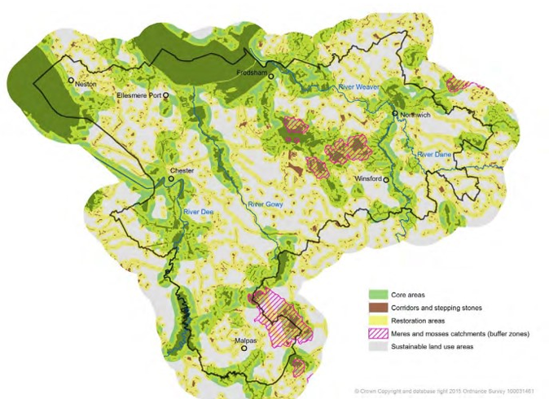
Cheshire West and Chester also contains several internationally important sites within the National Site Network, which is formally referred to as Natura 2000 sites), including Special Protection Areas (SPAs), Special Areas of Conservation (SACs) and Ramsar sites. These include:
The following sites fall within a 15km buffer of the borough boundary:
Areas of Nature Conservation Value (ANCV):
Local Nature Reserves (Statutory):
Non-statutory Nature Reserves:
Trees and woodland:
Habitats and Species:
These habits and species remain an important focus for conservation, restoration and enhancement, and will help inform Biodiversity Net Gain delivery and the Cheshire and Warrington Local Nature Recovery Strategy.
Nutrient impacts remain an important planning consideration for internationally designated water-dependent habitats within and around the borough. Any further development proposals within affected catchments will need to demonstrate that they will not adversely affect the integrity of protected sites through increased nutrient loading, taking account of the latest Natural England advice and relevant catchment strategies.
The area's waterways are also an important part of the green infrastructure within Cheshire West and Chester. A Green Infrastructure Feasibility Study was undertaken by the Mersey Dee Alliance exploring the green infrastructure objectives for the River Dee area, and how this could enable sub-regional growth. The River Dee is designated as a site of European importance (SAC) and the estuary a SPA and Ramsar site. There are also a number of other nature conservation designations linked to the area's waterways (SSSI's, SBI's etc) and they form important features in the landscape. Rivers are home to nationally rare flora and fauna and also locally important species and habitats. Therefore, maintaining and improving water quality is important. Water quality is also influenced by a number of factors outside the control of the planning system (e.g. agriculture).
Recent changes:
Anticipated trends:
Evidence gaps:
Proposed work:
The Local Plan can significantly influence biodiversity outcomes through its spatial strategy, site allocations and development management policies. It can protect designated sites, secure biodiversity net gain, safeguard ecological networks, support habitat restoration and require integration of nature-based solutions within new development.
Issues:
Opportunities:
| Sustainability objective | Appraisal criteria / sub-objective | Baseline indicator |
|---|---|---|
| Protect, enhance and manage biodiversity and geodiversity | Will it protect and promote effective management of the borough's sites of ecological and nature conservation importance? | The percentage area of land designated as sites of special scientific interest (SSSI) within the local authority area in favourable condition |
| Number and total area of new statutory and non-statutory nature conservation sites | ||
| Will it provide opportunities for the enhancement, creation or connection of habitats and to foster species conservation, diversity and resilience to climate change? | Number and total area of internationally and nationally designated nature conservation sites. | |
| Will it maintain, enhance and increase (rural and urban) tree cover and woodlands? | Scale of tree cover in rural and urban areas. |