Call for Sites 2026
The 'Call for Sites' will be open between Wednesday 14 October and Friday 6 November 2026. This is an opportunity to tell us about any land/site for potential development that has not been submitted to us previously.

The Waste Framework Directive (2008/98/EC) was incorporated into UK law primarily through the Waste (England and Wales) Regulations 2011.
The principles of self-sufficiency and proximity (commonly referred to as the ‘proximity principle’) are set out in Article 16 of the Waste Framework Directive. Local planning authorities are required, under regulation 18 of the 2011 Regulations, to have regard to these requirements when exercising their planning functions relating to waste management.
The Waste (England and Wales) Regulations 2011 require the preparation of waste management plans. They also set out the waste hierarchy:
National policy for waste planning is set out in the National Planning Policy Framework (2026) and the National Planning Policy for Waste (2014). The National Planning Policy for Waste should be read alongside the Waste Management Plan for England (2021).
The Waste Management Plan for England sets out the government’s ambition to work towards a more sustainable and efficient approach to resource use and management.
The NPPF does not include specific policies relating to waste and states that the National Planning Policy for Waste should also be considered where relevant. It does, however, highlight that achieving sustainable development has an environmental objective, which includes minimising waste. It also refers to a minerals and waste plan being a required part of the development plan and states that minerals and waste plans should set out specific proposals to enable the delivery of sustainable waste management and a circular economy.
The National Planning Policy for Waste requires waste planning authorities to prepare Local Plans that identify sufficient opportunities to meet the identifies needs of their area for the management of waste streams. It sets out the need to drive waste management up the waste hierarchy and to identify suitable sites or areas for waste management facilities. Appendix B of the National Planning Policy for Waste sets out specific locational criteria to be taken into consideration when testing the suitability of sites and areas. The locational criteria are:
The new NPPF does not include any revisions to the National Planning Policy for Waste. The NPPF consultation documents stated that the government intend to consult on revisions to the National Planning Policy for Waste in the future.
The PPG for waste identifies what comes within the scope of waste development. This includes:
The PPG for waste also states that there is no expectation that each local planning authority should deal solely with its own waste to meet the requirements of the self-sufficiency and proximity principles PPG for Waste Paragraph: 007 Reference ID: 28-007-20141016
CW&C is a member of the North West Waste Network and has regular meetings to discuss waste management issues.
CW&C is a unitary authority and is therefore also the waste planning authority.
A Waste Needs Assessment (WNA) for CW&C was prepared by BPP Consulting and was published in 2023. This concluded the existing consented capacity within CW&C is sufficient to meet the predicted management requirements for waste during the Plan period, apart from the requirement for non-inert landfill. Non-inert landfill is a landfill site that accepts waste that is not classified as inert, meaning that the waste can undergo physical, chemical or biological changes over time. The was a forecast shortfall in non-inert landfill provision from 2037, but this was expected to be more than offset by the substantial surplus in 'other recovery' capacity offered by the two Energy from Waste (EfW) plants under construction at that time. ‘Other recovery’ covers operations that involve something other than recycling and/or composting/anaerobic digestion. This includes EfW facilities, where waste is burnt to produce power and/or heat, provided they meet a minimum performance standard.
An update to the WNA was prepared by BPP in 2026 and the key findings are set out in the baseline information section below.
The WNA update found that a total of around 1.13 million tonnes of waste arose within CW&C in 2024. This is similar to the figure of around 1.12 million tonnes of waste found to arise within CW&C in 2021. Figure 4.1 shows the quantities of waste arising in CW&C by waste stream in 2024.
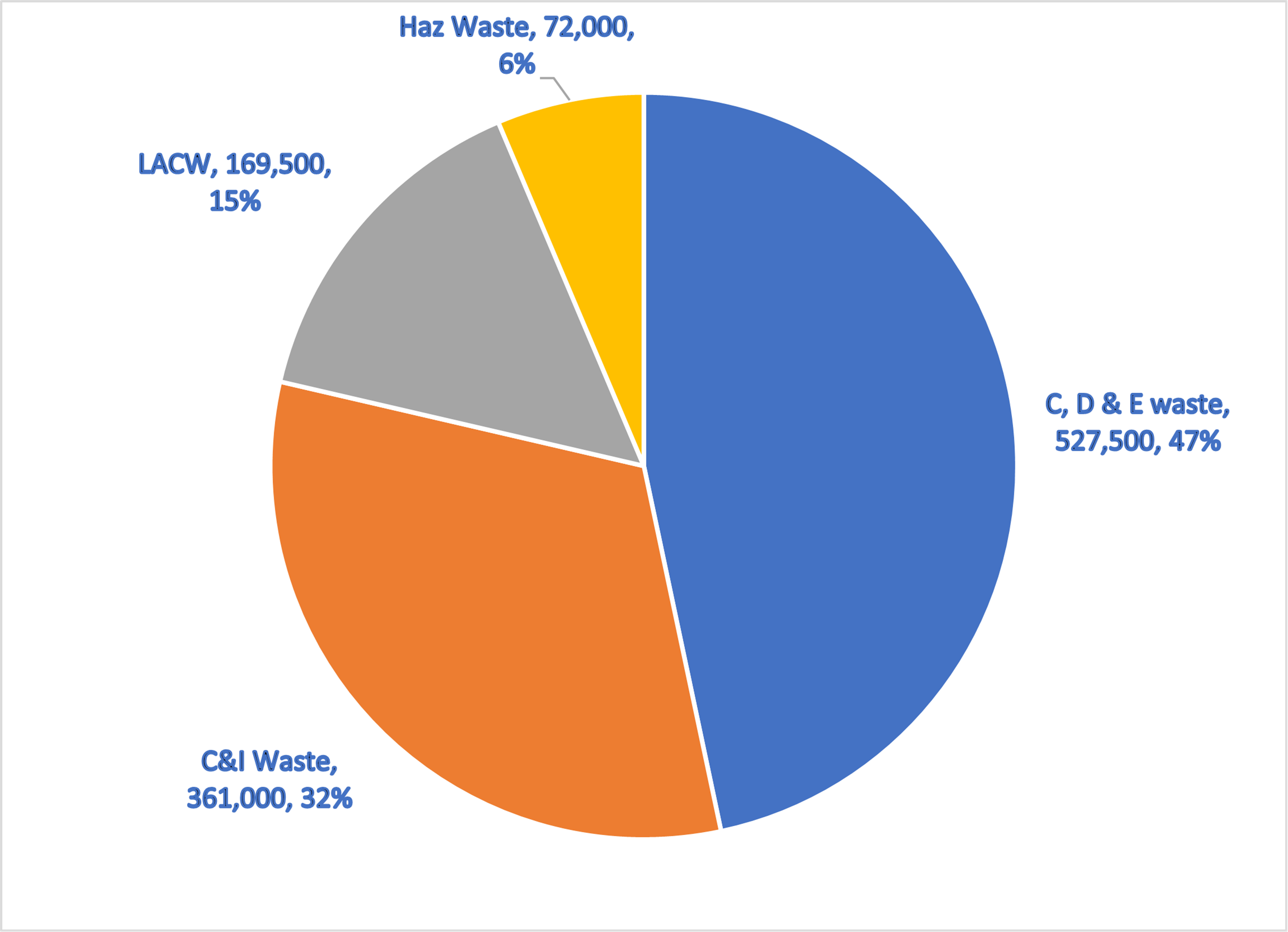
The current position in CW&C is that less than 1.5% of LACW goes to landfill. CW&C also has one of the highest recycling rates in the country, with over 59% of all waste successfully recycled (compared to 42% for England) (Department for Environment, Food and Rural Affairs – local authority collected waste management annual results).
The WNA identifies the current waste capacity within CW&C, as set out in table 4.1 below.
| Waste management type | Approximate capacity (tonnes) | Intermediate or final fate |
|---|---|---|
| Recycling | 1,142,858 | Intermediate |
| Metal recycling | 18,625 | Intermediate |
| Organic waste treatment | 299,958 | Intermediate |
| Household Waste Recycling Centres (HWRCs) | 32,686 | Intermediate |
| Recycled aggregate facilities | 488,336 | Intermediate |
| Waste transfer (reception and bulking of waste for subsequent management at other facilities) | 24,153 | Intermediate |
| Inert waste landfill | 0 | Final fate |
| Non-inert waste landfill | 0 | Final fate |
| Recovery to land | 0 | Final fate |
| Other recovery (residual waste / refuse derived fuel) | 1,100,000 | Final fate |
The table above includes all operational waste sites and sites with planning permission that are under construction. Sites with planning permission that are not yet under construction have not been included as there is a risk that they may not come forward and therefore may not contribute to the supply.
Protos (formerly known as Ince Park) was safeguarded in the Local Plan (Part Two) as a multi-modal resource recovery park and energy from waste facility for use in connection with the recycling, recovery and reprocessing of waste materials. Several plots at Protos have already been developed for waste or waste-related uses. he sites under construction include Protos Energy Recovery Facility (Plot 8) in Ellesmere Port and Lostock Sustainable Energy Plant near Northwich. These are both EfW plants.
There are several other plots / sites at Protos and Lostock Works that have planning permission for waste or waste-related uses, but they are not yet under construction.
The WNA update concluded that there appears to be sufficient existing consented capacity to meet the projected management requirements for: recycling/composting; ‘other recovery’ of residual non-hazardous Local Authority Collected Waste (LACW – also known as household waste); Commercial and Industrial waste (C&I – from business and industry) waste: and for inert waste (waste predominantly from Construction, Demolition and Excavation (CDE) that does not undergo changes over time) via recovery throughout the Plan period.
There was a site (Kinderton Lodge, near Middlewich) that had planning consent for a landfill site. The planning permission was implemented (started), but has now expired and the landfill cannot be constructed under the current permission. The WNA update identified that the consent holder's decision not to open Kinderton Lodge Landfill is predicted to lead to a cumulative deficit in non-hazardous waste landfill capacity of around 342,500 tonnes by the end of the Plan period. However, given that ‘other recovery’ capacity is more than sufficient to meet the identified ‘other recovery’ need, it can be expected to cater for the projected deficit in non-hazardous waste landfill capacity. In addition, the WNA Update identified that landfills with sufficient remaining void space to potentially manage the predicted shortfall in non-inert waste landfill capacity are located in Lancashire and Greater Manchester.
The WNA update also noted that as there is a policy expectation for waste to be driven up the waste hierarchy and a need to intensify recycling to reach the national target of halving residual waste production per head by 2042, proposals for capacity to move waste to higher tiers of the waste hierarchy (e.g. recycling) should not be constrained by the findings of the WNA Update.
The WNA Update 2026 forecasts waste management requirements in CW&C for each waste stream for 2030, 2035, 2040 and 2045, from a baseline in 2024. It then establishes the gap between capacity and requirements and produces a capacity gap. This is set out in table 4.2 below.
2030
| Capacity Type | Waste Management Capacity Gap (Tonnes at Plan Milestones) | |||
|---|---|---|---|---|
| 2030 | 2035 | 2040 | 2045 | |
| Recycling & Composting (Table 13) | +1,018,773 | +999,910 | +999,984 | +999,803 |
| Other Recovery (Table 14) | +965,235 | +973,954 | +973,724 | +973,495 |
| Non-inert Landfill (Table 15) | -17,970 | -14,375 | -14,406 | -14,436 |
| Aggregate recycling (Table 16) | +22,063 | +19,727 | +17,379 | +15,019 |
The predictions in the WNA Update 2026 take account of recent and proposed changes to recycling and producer responsibilities. Simpler recycling was introduced by government in 2024 and aims to enable consistent, more streamlined collections from households, businesses and non-domestic premises (such as schools and hospitals). This includes default requirements for separate collection of:
CW&C have had these collections in place for several years, but other authorities are only just introducing food waste collection etc. This will change future requirements for waste management and could increase demand for anaerobic digestion for example. Based on figures from 2024/25, CW&C was the 18th highest performing local authority in England in terms of total household waste sent for reuse, recycling or composting.
Extended Producer Responsibility reforms were introduced in 2024 through the Producer Responsibility Obligations (Packaging and Packaging Waste) Regulations 2024. In January 2025 a key phase came into force, making producers liable for disposal costs. This will impact on waste generation and recycling requirements.
Another key change is the Deposit Return Scheme, which is set to launch in October 2027. This aims to reduce litter and increase recycling rates by incentivising consumers to return empty beverage containers. The scheme will apply to single-use drinks containers made from plastic and metal. This will result in changes to levels of recycling.
A circular economy taskforce was established in 2024 to help prepare England’s first Circular Economy Strategy. This has been delayed and is now expected to be consulted on by government during 2026.
The recent and proposed changes in government policy will result in substantial changes in waste arisings, recycling performance and residual waste treatment requirements.
As the WNA Update was published in June 2026, there are no major evidence gaps at this point. Monitoring of waste-related planning applications will be undertaken on an annual basis.
The Local Plan can influence the location and provision of waste facilities by allocating sites and / or criteria-based policies relating to new waste developments. The Local Plan can also safeguard existing waste facilities and can prevent new development in areas adjacent to existing or proposed waste limiting future operation of facilities. This is known as the ‘agent of change’ principleParagraph 200 of the NPPF 2025. Movement of waste is normally based on market decisions (cost and distance) and as such, the Local Plan has relatively little influence over this, beyond the location of new sites. Any future changes to the waste hierarchy and the priority given to different types of waste management, recycling and disposal often relates to government policy and taxation and is therefore difficult to control through planning policies.
Policies on sustainable construction can support re-use and recycling of materials and other policies can help to promote recycling and re-use, but most of the factors that impact on recycling rates and use of recycled materials are outside the planning process and therefore cannot be influenced by the Local Plan.
| Sustainability objective | Appraisal criteria / sub-objective | Baseline indicator |
|---|---|---|
| Minimise waste generation and manage waste in accordance with the waste hierarchy | Will it help to reduce the amount of waste generated? | Local Authority Collected Waste |
| Total amount of Commercial and Industrial Waste | ||
| Kilogrammes of household waste collected per head | ||
| Will it encourage increased re-use, recovery, recycling, or composting? | % of local authority collected waste recycled and composted | |
| % of local authority collected waste sent for energy recovery | ||
| % of commercial and industrial waste recycled | ||
| Will it reduce the amount of waste sent for incineration or landfill? | % of local authority collected waste landfilled | |
| Amount of commercial and industrial waste produced in the borough sent for energy recovery / landfill / treatment | ||
| Will it result in new or enhanced waste management facilities? | Capacity of new waste management facilities |