7.1 Policy context - landscape and townscape
International
The Council of Europe Landscape Convention ‘Promotes the protection, management and planning of the landscapes and organises international co-operation on landscape issues.’ (Council of Europe Landscape Convention / Official website- Council of Europe Landscape Convention.
National
The NPPF Chapter 19: ‘Conserving and Enhancing the Natural Environment’ requires planning policies and decisions to:
- Protect and enhance the natural environment and valued landscapes.
- Recognise and respond to the character, needs and opportunities of each area.
- Conserve and enhance landscape and scenic beauty in National Parks, the Broads and National Landscapes.
- Support nature conservation, habitat enhancement, restoration and creation that contribute to environmental improvement.
- Ensure development contributes positively to local character, distinctiveness and visual quality through good design.
The NPPF Chapter 12: ‘Achieving Well-Designed Places’ requires development to:
- Function well and add to the overall quality of an area.
- Be visually attractive.
- Be sympathetic to local character, landscape setting and built form.
- Create places with a strong sense of identity and distinctiveness.
The PPG provides detailed guidance supporting the NPPF. Relevant topics include:
- Design
- Historic Environment
- Natural Environment
- Environmental Impact Assessment
- Effective use of land
It guides how landscape, visual, townscape and heritage considerations should be assessed and weighted in planning decisions.
Regional
Cheshire and Warrington Sub-Regional Strategy includes the following key priorities:
- Protecting and enhancing the natural environment.
- Conserving the area's distinct landscape character.
- Supporting sustainable growth while safeguarding heritage assets.
- Strengthening cultural heritage as an economic and tourism asset.
- Promoting place-making and high-quality design.
The draft Cheshire AONB Designation Project - Natural Beauty Assessment identifies areas that are likely to meet Natural England’s natural beauty criteria and could potentially form a provisional Candidate Area for a potential designation.
Local
- Cheshire Landscape Character Assessment
- A Landscape Strategy for Cheshire West and Chester Borough 2016 (the Landscape Strategy)
7.2 Policy context - heritage
International
The UNESCO World Heritage Convention (1972) promotes the identification, protection and conservation of cultural and natural heritage of Outstanding Universal Value.
The European Convention on the Protection of the Archaeological Heritage (Valletta Convention, 1992) provides a framework for the protection, conservation and management of archaeological heritage.
The Council of Europe Framework on the Value of Cultural Heritage for Society (Faro Convention, 2005) promotes recognition of the social value of cultural heritage and has influenced heritage practice, community heritage approaches and place-based planning internationally, although the United Kingdom is not a Party to the Convention.
The Convention for the Protection of the Architectural Heritage of Europe (Granada Convention, 1985) provides a framework for the conservation and protection of architectural heritage across Europe.
National
- Planning (Listed Buildings and Conservation Areas) Act 1990 provides statutory protection for listed buildings and conservation areas.
- Ancient Monuments and Archaeological Areas Act 1979 provides protection for scheduled monuments and nationally important archaeological remains.
- National Heritage Acts provide the statutory basis for Historic England and its functions relating to the protection, conservation and promotion of England's historic environment.
- Historic England Corporate Plan and Heritage at Risk Programme provide a framework for heritage protection, enhancement and monitoring.
- Historic England guidance and the National Heritage Acts provide the principal national framework supporting protection, conservation and enhancement of the historic environment.
- Historic England Good Practice Advice Notes: GPA 2: Managing Significance, GPA 3: Setting of Heritage Assets, GPA 4: Enabling Development, GPA 7: Local Heritage Listing.
The NPPF includes the following requirements:
- Sustain, conserve and where appropriate enhance or better reveal the significance of heritage assets and their settings.
- Recognise the contribution of designated and non-designated heritage assets to local character, distinctiveness, placemaking and sustainable development.
- Secure viable uses consistent with the conservation of heritage assets.
- Take account of opportunities to draw on the contribution made by the historic environment to local character and sense of place.
- Ensure harm to heritage significance is clearly justified and balanced against public benefits.
- Promote well-designed places that respond positively to local history and character.
- Ensure plans and decisions are informed by proportionate assessment of significance, archaeological interest and heritage impacts.
- Use robust evidence relating to heritage assets, conservation areas, archaeology and historic character.
- Plans should set out a positive strategy for the conservation and enjoyment of the historic environment, including heritage assets most at risk through neglect, decay or other threats.
- Local planning authorities should maintain or have access to an up-to-date Historic Environment Record and use it to inform plan-making and decision-making.
The NPPF Chapter 16: ‘Conserving and Enhancing the Historic Environment’ states that:
- Heritage assets are an irreplaceable resource.
- They should be conserved in a manner appropriate to their significance.
- Local plans should contain positive strategies for conservation and enjoyment of the historic environment.
- Development affecting heritage assets must assess significance and impacts on that significance.
Planning Practice Guidance on the Historic Environment includes:
- Guidance on assessing significance, setting and heritage impact.
- Guidance relating to heritage significance, public benefits, substantial harm, archaeology, settings and decision making for designated and non-designated heritage assets.
- Guidance on archaeological assessment and investigation.
- Guidance relating to conservation areas, listed buildings, scheduled monuments and non-designated heritage assets.
Regional
- Heritage at Risk initiatives operating across Cheshire and the North West.
- Cross-boundary management of historic landscapes, canal networks and archaeological resources.
Local
- Conservation Area Appraisals and Management Plans.
- Cheshire West and Chester Heritage Strategy (consultation 2025/26).
- Cheshire Historic Environment Record (HER).
- Cheshire Local Heritage List.
- Chester Characterisation Study (2012).
- Cheshire West and Chester Design Code (consultation draft 2025).
7.3 Baseline information – landscape and townscape
There are 20 different landscape character areas across Cheshire, with a diverse range from coastal to sandstone ridges located in Cheshire West and Chester. There are also 12 historic landscape character groups, further broken down into 34 character types, which can be used to assess capacity to accommodate change. It is important that the character of the landscape is understood when considering how it might change, so that any change will be for the better. A number of parishes within the borough have completed Village Design Statements. These documents detail the local character and features that make these areas distinct, setting out guidelines for new development. The landscape character types throughout Cheshire West and Chester can be seen below (Figure 7.1).
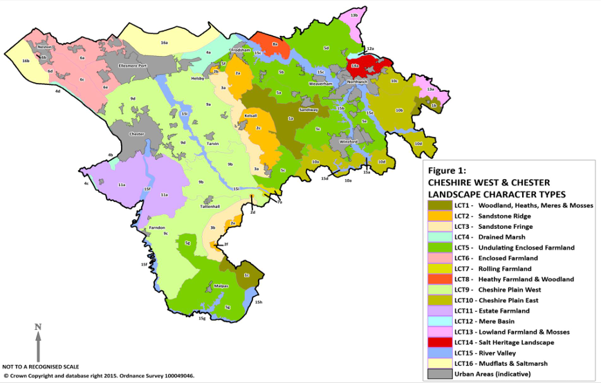
Figure 7.1 CW&C landscape types
The following ASCVs have also been identified for their combined significance of features of historic, landscape, archaeological and nature conservation value:
- Beeston/Peckforton/Bolesworth
- Dee Coastal Area
- Delamere/Utkinton
- Grosvenor Estate/Dee Valley
- Helsby and Frodsham Hills
- Weaver Valley
- Willington
- Wych Brook Valley
7.4 Baseline information – heritage
Cheshire West and Chester possesses a rich and diverse historic environment which contributes significantly to local identity, character, sense of place and economic vitality. The borough contains internationally, nationally and locally important heritage assets, reflecting its Roman origins, medieval development, industrial heritage and historic rural landscapes.
The historic city of Chester contains one of the best-preserved historic townscapes in England and is recognised for its exceptional concentration of heritage assets, including the city walls, Rows, cathedral and extensive archaeological remains.
The borough contains a wide range of designated and non-designated heritage assets, including listed buildings, conservation areas, scheduled monuments, registered parks and gardens, historic landscapes, canals, archaeological sites and locally important heritage assets.
Development, infrastructure projects, environmental change and inappropriate alterations have the potential to affect the significance, setting and condition of heritage assets. Continued investment and positive management are therefore required to conserve heritage assets and secure their long-term beneficial use.
The borough contains the following heritage resourcesData sourced from the National Heritage List for England, Historic England Heritage at Risk Register and Cheshire Historic Environment Record (November 2025). Historic England's Heritage at Risk Register identifies heritage assets requiring priority conservation action, with the Council and partners working to secure improvements where possible.:
| Scheduled Monuments | 118 |
| at Risk | 10 |
| Listed Buildings (records) | 2,523 |
| Grade I | 86 |
| Grade II* | 175 |
| Grade II | 2,262 |
| at Risk | 9 |
| Locally Listed Buildings | 1,313 |
| Conservation Areas | 96 |
| Registered Parks and Gardens | 7 |
| at Risk | 0 |
| Registered Battlefields | 1 |
| at Risk | 0 |
| World Heritage Sites | 0 |
| Areas of Archaeological Potential | 12 |
| Area of Archaeological Importance | 1 |
The borough contains archaeological evidence spanning prehistoric, Roman, medieval and post-medieval periods. Significant archaeological resources are concentrated in Chester, along historic transport corridors and within rural landscapes.
The borough includes historic landscapes, including parklands, canals, agricultural landscapes and settlement patterns, many of which contribute strongly to local distinctiveness and often extend across administrative boundaries. Their significance can be affected by cumulative change, development pressures and climate change.
7.5 Recent changes and anticipated trends – landscape and townscape
- Continued regeneration within Chester and key town centres.
- Increasing focus on placemaking and design quality.
- Greater recognition of green infrastructure and landscape-led approaches to development.
- Progression of work considering potential National Landscape designation areas.
- Continued pressure for housing and employment development in and around existing settlements.
- Increasing demand for high-quality public realm and accessible green spaces.
- Greater emphasis on climate adaptation within landscape design.
- Continued growth in heritage tourism and cultural investment.
- Increased use of landscape-led masterplanning and design coding.
7.6 Recent changes and anticipated trends – heritage
- Continued expansion of the Cheshire Local Heritage List.
- Growing recognition of heritage as a driver of placemaking, regeneration and economic growth.
- Increased use of conservation area appraisals, character studies and heritage evidence in plan making and development decisions.
- Continued investment in heritage-led regeneration projects, particularly within town and city centres.
- Greater emphasis on reducing the number of heritage assets at risk.
- Ongoing development and regeneration pressures in urban centres and strategic growth locations.
- Increased recognition of the role of heritage in supporting tourism, cultural identity and town centre vitality.
- Growing emphasis on the reuse and retrofit of historic buildings to support climate change objectives.
- Increased consideration of climate-related impacts on historic buildings, archaeological remains and historic landscapes.
- Greater integration of heritage considerations into placemaking and design-led approaches to development.
- Continued growth in the identification and recognition of locally significant heritage assets.
7.7 Evidence gaps and proposed work – landscape and townscape
Evidence gaps:
- Updated landscape sensitivity assessments for growth locations.
- Updated landscape strategy
- Detailed townscape analysis in key regeneration areas.
- Further evidence relating to potential National Landscape designation areas.
Proposed work:
- Update landscape and visual evidence where required.
- Assess cumulative landscape and townscape impacts of proposed growth areas.
- Review impacts on strategic views and settlement separation / key settlement gaps.
7.8 Evidence gaps and proposed work – heritage
Evidence gaps:
- Up-to-date condition assessments for heritage assets across the borough.
- Assessment of the implications of strategic site allocations on the settings of designated heritage assets, including cumulative impacts.
- Current understanding of the condition and significance of non-designated heritage assets.
- Assessment of climate change risks and adaptation requirements for heritage assets.
- Updated evidence relating to archaeological potential in strategic growth locations.
- Monitoring information regarding heritage assets at risk and vacant historic buildings.
- Assessment of cumulative impacts on historic townscapes, landscapes and settings.
- Review of conservation area boundaries, appraisals and management plans where evidence indicates they may no longer reflect current heritage significance.
Proposed work:
- Review and update Historic Environment Record evidence where necessary.
- Continue preparation and review of Conservation Area Appraisals and Management Plans.
- Continue development and maintenance of the Cheshire Local Heritage List.
- Liaise with Historic England regarding Heritage at Risk priorities and data.
- Assess impacts of proposed growth options on heritage significance, setting and historic character.
- Review evidence relating to archaeological potential and requirements for investigation.
- Consider implications of climate change adaptation and retrofit measures for historic assets.
7.9 Local Plan scope and influence – landscape and townscape
The Local Plan can strongly influence landscape, townscape and heritage outcomes through site allocations, spatial strategy, design policies and development management policies. It can direct development away from sensitive locations, protect valued landscapes and heritage assets, require high-quality design and secure landscape enhancements associated with new development. The Local Plan can also support heritage-led regeneration, public realm improvements and green infrastructure provision.
7.10 Local Plan scope and influence – heritage
The Local Plan can:
- Protect designated and non-designated heritage assets.
- Support identification and protection of locally listed heritage assets and areas of archaeological potential through site allocations and development management policies.
- Conserve and enhance the significance and settings of heritage assets.
- Protect archaeological remains and areas of archaeological potential.
- Promote high-quality design that responds positively to local character and distinctiveness.
- Support conservation-led regeneration and the beneficial reuse of historic buildings.
- Protect historic landscapes, parks, gardens and canal corridors.
- Require proportionate heritage impact assessments where appropriate.
- Reduce the number of heritage assets at risk through positive planning policies.
- Enhance townscape quality, local identity and sense of place.
- Support sustainable adaptation and retrofit of historic buildings where this conserves heritage significance.
- Climate change adaptation, resilience and energy-efficiency improvements should be delivered in ways that conserve heritage significance and avoid harm to the special interest of historic buildings, archaeological remains and historic landscapes.
The Local Plan has a high level of influence over the protection, management and enhancement of the historic environment through the spatial strategy, site allocations, design requirements and development management policies. It can play a significant role in ensuring growth supports the conservation and enhancement of the borough's historic environment and cultural heritage.
7.11 Key sustainability issues and opportunities – landscape and townscape
- Development pressure on valued landscapes and countryside.
- Loss of local distinctiveness through poorly designed development.
- Urban expansion affecting settlement identity and important views.
- Cumulative landscape and townscape impacts from incremental development.
- Promote landscape-led development and placemaking.
- Deliver high-quality design reflecting local character.
- Enhance public spaces, green infrastructure and townscape quality.
- Protect and strengthen local distinctiveness.
- Enhance enjoyment and appreciation of cultural heritage and landscapes.
7.12 Key sustainability issues and opportunities – heritage
- Development pressure affecting designated and non-designated heritage assets and their settings.
- Neglect, vacancy and deterioration of some historic buildings and structures.
- Heritage assets at risk requiring conservation action.
- Loss of local distinctiveness and historic character through inappropriate development and design.
- Climate change impacts on historic buildings, archaeological remains, conservation areas and historic landscapes.
- Increased flood risk affecting heritage assets and historic townscapes.
- Overheating and deterioration risks affecting historic buildings.
- Pressures arising from adaptation and energy-efficiency retrofitting of historic buildings.
- Balancing the need for growth with heritage conservation objectives.
- Pressure to retrofit historic buildings to improve energy efficiency whilst conserving heritage significance.
- Promote heritage-led regeneration within Chester, town centres and local centres.
- Bring vacant and underused heritage assets back into beneficial use.
- Protect and enhance Chester's nationally significant historic townscape and archaeological resource.
- Use heritage assets to strengthen local identity, sense of place and tourism.
- Encourage sensitive adaptation, retrofit and reuse of historic buildings.
- Improve public access to, understanding of and engagement with heritage assets.
- Integrate heritage considerations within high-quality placemaking and design.
- Enhance historic landscapes and cultural routes, including canals and historic corridors.
7.13 SA framework – landscape and townscape
| Sustainability objective | Appraisal criteria / sub-objective | Baseline indicator |
|---|---|---|
| Protect, enhance and manage the character and appearance of the landscape and townscape, maintaining and strengthening local distinctiveness | Will it protect or enhance landscapes or townscapes? | Percentage of conservation areas with an up-to-date appraisal and management plan |
| Will it provide high quality design? | No indicator identified. |
7.14 SA framework – heritage
| Sustainability objective | Appraisal criteria / sub-objective | Baseline indicator |
|---|---|---|
| Conserve and enhance the historic environment, cultural heritage, archaeological resources and historic character of places. | Will it conserve or enhance designated heritage assets and their settings? | Number of historic assets on Historic England's Heritage at Risk Register by asset type; number of conservation areas |
| Number of assets removed from England's Heritage at Risk Register | ||
| Will it conserve or enhance non-designated heritage assets and local character? | Number of assets included on the Cheshire Local Heritage List | |
| Will it protect archaeological resources and areas of archaeological potential? | Number of archaeological sites recorded in the Historic Environment Record; number of archaeological assets affected by development |